
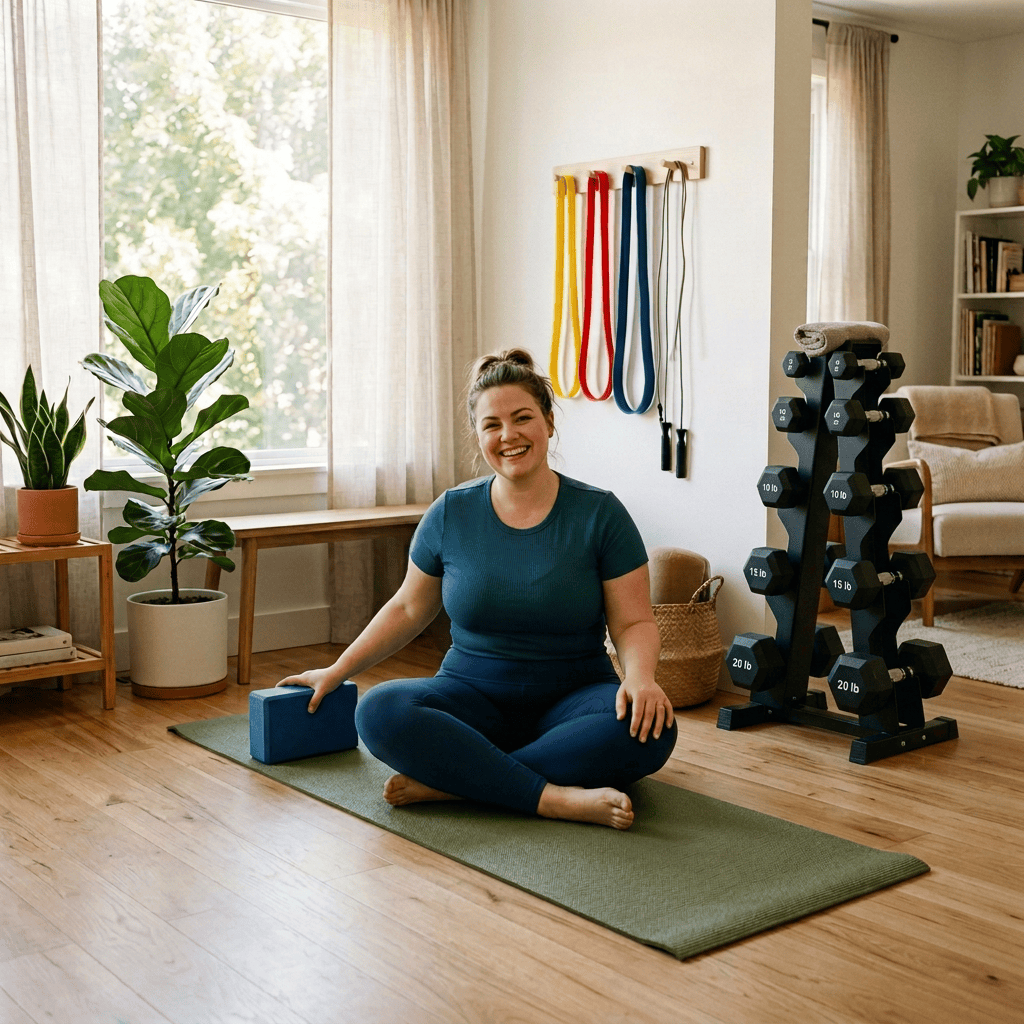
As promised, here is my second article about lifestyle habits that can support your journey while taking GLP-1 medications. In my previous article, I shared my thoughts on nutrition. Today, we’re talking about exercise.
Exercise is a specific type of physical activity that is structured and performed with a goal—in other words, your workouts.
But workouts aren’t the only movement that matters. Everyday activities such as housework, climbing stairs, walking around the house, and even typing contribute to our total physical activity. All of this movement plays an important role in our energy balance and overall health.
For the average person, this everyday movement, known as NEAT (Non-Exercise Activity Thermogenesis), is a larger contributor to daily energy expenditure than intentional exercise. Exercise, or EAT (Exercise Activity Thermogenesis), typically accounts for a smaller portion.
So, if exercise burns fewer calories than everyday movement, why does it matter?
Because exercise serves a purpose beyond burning calories.
For people taking GLP-1 medications, one of the most important purposes of exercise is helping preserve muscle mass and bone health during weight loss. And that is no small feat.
Strength, cardio, or mobility?
The three main categories of exercise are strength, cardio (aerobic exercise), and mobility. Each has a role to play, but strength training deserves particular attention when you’re taking a GLP-1 medication.
Weight loss can include some loss of muscle mass, and potentially bone mass as well. Our goal isn’t simply to make the number on the scale go down—we want to maximize fat loss while preserving as much lean tissue as possible. That’s where strength training comes in.
Strength training gives your muscles a reason to stay. When we regularly challenge our muscles, we send a signal to the body that this tissue is needed. The forces generated by muscle contractions also place beneficial stress on the bones, helping support bone strength and integrity.
Aerobic exercise is valuable, too. It increases energy expenditure and provides many health benefits, particularly for cardiovascular health.
Ideally, you want both strength and aerobic exercise in your routine. But if you have to choose just one, strength training should generally be the priority during weight loss.
Lastly, mobility work helps us stay flexible, functional, and comfortable as we move through everyday life. It can be especially useful for maintaining range of motion and reducing stiffness. However, mobility exercises generally don’t provide the same stimulus for maintaining muscle and bone or increasing energy expenditure.
Strength training recommendations to support your GLP-1 journey
The general recommendation is the same as it is for adults overall: aim for at least two non-consecutive days of strength training per week, working the major muscle groups. That’s a great place to start if you’re new to exercise.
For example, a beginner full-body routine could include 2–3 sets of approximately 8–10 repetitions of the following exercises. The entire workout could take about 20–30 minutes, twice a week:
- Squats
- Romanian deadlifts or hip hinges
- Lunges or step-ups
- Calf raises
- Push-ups (on your knees if needed)
- Superman or bird dogs
- Glute bridges
- Dead bugs
- Bicycles
You can start with body weight alone. As you become stronger and more comfortable with the exercises, gradually add resistance using weights or resistance bands.
You can also introduce additional functional exercises such as shoulder presses, triceps dips, sit-ups, rows, Russian twists, and woodchoppers.
What if you want to exercise three or four days a week?
Eventually, you may want to add a third strength-training day. Instead of doing three identical full-body workouts, you could split your routine. For example:
- Day 1: Upper body and core
- Day 2: Lower body
- Day 3: Full body
This allows you to work each major muscle group twice a week while adding variety to your workouts. Variety can also help with motivation and, over time, your progress.
If you were already doing strength training before starting a GLP-1 medication, you can generally continue with your existing routine, adjusting the intensity as needed based on your energy levels and how you feel.
As you become stronger, gradually increase the challenge (ideally by adding resistance) to continue stimulating your muscles and bones.
In general, I recommend no more than four days of strength training per week. If you are training four days, consider dividing your workouts by movement pattern or muscle group, such as push/pull or upper/lower body.
Most importantly, avoid training the same muscle groups hard on consecutive days. Recovery is not time away from training, it is part of training.
And what about cardio?
If your energy and schedule allow, absolutely include cardio.
It can be as simple as a 15–30 minute brisk walk most days, or something more demanding, such as jogging or alternating walking and jogging.
A good long-term goal is to build toward at least 150 minutes of moderate-intensity aerobic activity per week, with potential additional benefits as you approach 300 minutes per week.
When possible, consider including some weight-bearing cardio, such as walking, hiking, jogging, using an elliptical, or climbing stairs. Weight-bearing activities provide mechanical stimulation to the bones, which is one reason they can be particularly valuable during weight loss. Non-weight-bearing activities such as cycling, rowing, or swimming are still excellent forms of cardiovascular exercise. They simply don’t provide the same weight-bearing stimulus to your bones.
If you’re already well trained, you may also choose to incorporate HIIT (High-Intensity Interval Training) once or twice a week. However, HIIT is optional. You do not need it to benefit from exercise.
Should you change your workouts around your injection day?
Many GLP-1 medications are taken once a week. Some people experience side effects such as nausea, fatigue, or gastrointestinal discomfort, particularly during the 24–48 hours following an injection. These symptoms may be more noticeable during the first few weeks of treatment, while your body is adjusting to the medication and your healthcare provider is determining the appropriate dose.
For this reason, some people may find it helpful to schedule their more demanding workouts later in the week, when they are feeling better, and use the first couple of days after the injection for gentler activity.
For example, your week could look something like this:
- Monday – Injection day: rest or normal daily activity
- Tuesday: rest or very light cardio (such as a 20–30 minute gentle walk), or mobility.
- Wednesday: right-to-moderate cardio, such as a 20–40 minute steady walk or walking intervals, as tolerated
- Thursday: strength workout 1 (full body, moderate resistance)
- Friday: cardio (20–45 minute brisk walk, jog, or walk/jog combination), and optional mobility.
- Saturday: strength workout 2 (upper body)
- Sunday: strength workout 3 (lower body)
This is only a suggestion. Your personal schedule should be based on your medication, symptoms, fitness level, recovery, and your healthcare provider’s recommendations.
If you’re experiencing significant nausea, dizziness, weakness, or other concerning symptoms, it’s better to scale back and discuss them with your healthcare provider rather than pushing through a workout.
In conclusion
When using GLP-1 medications for weight loss, the goal isn’t simply to lose weight. We want to maximize fat loss while supporting muscle and bone health along the way. Exercise can play an important role.
Here are the key takeaways:
- Prioritize strength training 2–4 days per week, depending on your experience and fitness level. If you’re exercising two days, full-body workouts are a great option. With three or four days, you can consider splitting workouts by muscle group or movement pattern. If you split your workouts, aim to train each major muscle group approximately twice a week.
- Add cardio when possible. Aim for at least 150 minutes of moderate-intensity aerobic activity per week, gradually building toward more if appropriate. Brisk walking, hiking, and light jogging are all great options.
- Include weight-bearing activities when possible to provide additional stimulus to your bones.
- HIIT is optional. If you’re intermediate to advanced and enjoy it, one or two sessions per week can be incorporated into your routine.
- Listen to your body around injection day. If you experience side effects after your injection, keep those days lighter and save harder workouts for when you’re feeling better (often 48 hours or more afterward).
Most importantly, remember that more exercise isn’t necessarily better. The goal is to find a sustainable routine that challenges your body, supports your health, and allows enough time for recovery.
I hope this article has given you some practical ideas for using exercise to support your GLP-1 weight-loss journey.
Be well and strong,
Isabel

