

I used to say that the best medicine was preventive medicine. But I no longer think so. Now, I believe that the best medicine is the lifestyle medicine. Twin studies have found that our genes only account for about of 25% of our health spam, which means that we do have a lot of power on our health and wellness with our lifestyle choices – a full 75%.
The diagram below depicts the so-called Health and Wellness continuum as formulated by John Travis, M.D. As we can see, there is significant improvement potential beyond a neutral point where there is no discernible illness. This improvement is achieved through our holistic lifestyle choices. The lifestyle medicine focuses mainly on this right side of the continuum, helping us minimize the risk of developing illness. It will also help us function at optimal levels, no only physically, with features like high energy or healthy digestions, but also mentally, socially, intellectually and all other dimensions of holistic health. Lifestyle medicine can also treat conditions, especially chronic ones. For example, with the right diet and exercises, pre-diabetes, type 2 diabetes or obesity can be reversed in most cases.
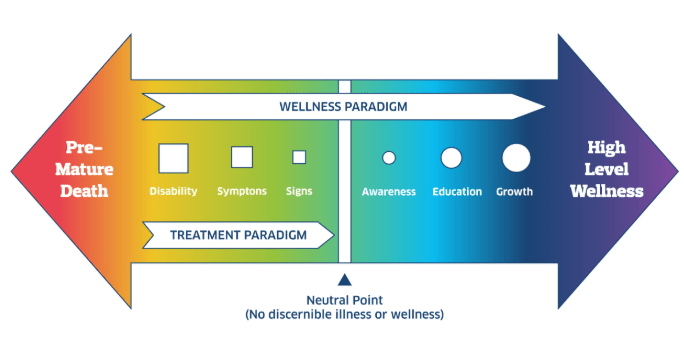
Lifestyle medicine does not replace classic medicine
Lifestyle medicine has the potential to minimize our chances to get sick, and even treat illness. But it does not guarantee that we do not get sick at all, as there are factors that we cannot fully control, like our age, genes, gender or race, or the microorganisms that we are exposed to. Here is when classic medicine, the medicine of diagnose and treatment, usually with drugs, is necessary: it can help us restore our health and save lives. Lifestyle medicine and classic medicine go hand in hand and both play a critical role in our wellness.
Both types of medicines work better together. One may prefer to start with a lifestyle approach, but serious conditions may require drugs, surgery or other disruptive treatments. And likewise, when we are under one of these treatments, we may want to still leverage lifestyle components like an antioxidant rich diet or mild exercise, to boost treatment effectiveness.
Lifestyle medicine outcomes are proven by research
Sometimes lifestyle medicine, also called functional or root cause medicine, is qualified as pseudoscience. But it is not, as both observational and causality studies have demonstrated its veracity. I have personally experienced the benefits of a change in my diet, as I will share below.
- The Danish Twin Study concluded that longevity seems to be only moderately heritable: 23% for females, 26% for males. That is about 25% average dependence on genetics.
- The well-known Blue Zones Project is an observational study, which showed that modifiable factors like lifestyle and environment have the most significant impact on population-level health outcomes.
- The Stanford Twin Nutrition Study (TwiNS) did actually prove causality, demonstrating that people with identical genes do achieve different health markers when they adopt different lifestyles. In the omnivore vs. vegan TwiNS study, 22 pairs of identical twins were put on a different diet: one twin ate a well-planned strict plant-based diet, whereas the other twin ate an quality omnivore plan. This study concluded that the healthy vegan diet improves metabolic health in just eight weeks:
- Lower blood cholesterol levels: vegans LDL cholesterol dropped by 15.2 mg, whereas omnivores LDL cholesterol fell by 2.4 mg. Personally, I can attest the big impact that a plant-based diet has had in my cholesterol levels, way over my previous healthy omnivore diet: over 80 mg in my case.
- Lower body weight: vegan participants lost 4 more pounds than omnivores. Likewise, I have lost more than 10 pounds with a vegan diet, not even purposely chasing weight loss.
- Lower fasting insulin: vegans fasting insulin dropped by 20% more than omnivores. My do not know my insulin levels, but my fasting glucose is consistently lower since I follow a vegan diet. Fasting glucose is related to insulin levels in healthy people.
- Longer telomeres: telomeres are protective “caps” of repetitive DNA sequences at the ends of chromosomes that protect genetic information during cell division. Vegans had longer telomeres at the end of the eight weeks, compared to their omnivorous twins, whose telomeres remained unchanged. This means the vegan twins were considered biologically younger than their omnivore twins
A single study does not conclusively proves anything, specially a small study like TwiNS, but the results are consistent and give us good information to make informed decisions with our lifestyle.
Why lifestyle medicine sometimes gets a bad rap?
I think that a big issue with lifestyle medicine is how it is implemented by each specific doctor. Or maybe even going a step further, who is called a “doctor”. Are physicians, chiropractors, osteopaths and physical therapists doctors? Yes, they are. Even if their training is different, their scope of practice partially overlaps, which can cause confusion.
Some lifestyle doctors are more prone to use therapies or supplements that have not been fully proved for efficacy or even safety, like vibration platforms or energy healing. It’s up to the individual to try – or not – these alternative solutions. Furthermore, some professionals may even discourage the use of treatments that have been proved by research, like vaccines.
And let’s remember that, sadly, there are many commercial and business interests on what is studied and proved. Medical studies need money, and some pharmaceuticals may be happy to finance if that’s going to increase their drug sales. But nobody will become billionaire by promoting broccoli and walking in nature. Who is going to prove a study that shows that broccoli and walking in nature are as powerful for our health than popping a specific pill? A vibration platform or supplement study? Those ones might get funding from the brand. I do not oppose to these options, and personally I’ve tried and achieved good results with them. It’s all a matter of making an informed decision driven by critical thinking.
A different outlook?
What if medicine would also focus on getting positive outcomes and avoiding illness and disability via lifestyle interventions? Things like preventing and treating cardiovascular disease starting with a prescription of a plant-forward, DASH or Mediterranean diet, exercise and stress management, instead of statin and benzodiazepine medication? And if the lifestyle intervention is not enough, then by all means, let’s add the pills.
What if your first prescription was a change in daily habits, along with a referral to a Health Coach to make it work?
Pills are necessary and life saving, but in my opinion, they should be a secondary resort, to complement lifestyle interventions if, and only if, needed.
Unfortunately, pills can cause side effects, and then another pill may be need to treat those side effects. Statins are notorious for their unpleasant side effects, whereas a moderate exercise is not. Wouldn’t it be best to at least try to avoid those side effects?
Bridging the gap: Health and Wellness coaching
Most of us know the generalities of what to do for health: move more, eat healthy, get quality sleep, unwind, and so on. Many times, doctor’s advice is just as vague as this. But let’s imagine that traditional doctors and medicine schools would start teaching lifestyle interventions, and physicians would prescribe more specific foods, movement or unwind techniques. Some doctors already do this, but it’s their own work and effort, not because medicine is taught this way nowadays. On the bright side, there are healthcare professionals like Registered Dietitians that can work as a team with physicians to cover some lifestyle areas, but that’s not the norm yet.
OK, so let’s imagine that you have your lifestyle prescription. Next question is: how do we implement these new lifestyle habits and make them sustainable? We can always try on our own. There is someone who can help too: Health and Wellness coaches. This is a new healthcare role that can partner with the individuals willing to make lasting habit changes, guiding them to adopt those lifestyle interventions in a way that works for them, specifically. A coach will work with a client to setup a wellness vision, and define the steps to achieve it, via SMART goals and other commitments that the client chooses, based on their lifestyle prescription.
Conclusion
All types of medicine are needed. Lifestyle medicine can help us prevent illness in the first place, and contribute to healing. Classic medicine can complement where the lifestyle medicine falls short. So why not start with lifestyle choices to optimize our wellness, and use classic medicine selectively, whenever needed, but not as our first choice?
You can educate yourself and try on your own for generic prevention and optimization. Even better, talk to a health coach or functional doctor.
But always consider traditional medicine if you develop symptoms. Get vaccinated, and also eat healthy and exercise to boost your immunity. These are complementary approaches, and they are more protective and powerful together.
Be well,
Isabel
 thrivebytheslice.com