

Many of us spend 8 hours, one third of our day, working. That’s half of our awake time. No wonder why occupational wellness is one of the pillars of holistic wellness. How we feel with respect to our job has big implications in all other areas of our wellness: mental, social, intellectual, and even physical. Even for those who love their job and are not enticed to change, having a career plan is a good idea, simply because things and situations are in continuous evolution. We’d better take control and direct our ship in the direction we like, instead of being carried for whatever type of wind blows tomorrow. Having a career plan also stimulates our intellectual wellness, our social wellness and even our community wellness, exposing us to new knowledge, new people and new organizations.
In this article, I am going to provide some tips about how to develop a career plan, whether you are actively pursuing a change or not.
Setting a career vision
In health and wellness coaching we usually start by setting a “Wellness vision”, the general umbrella that will guide our actions. For the same token, when it comes to career, we might want to start by setting a “Career vision”.
A career vision is how we picture ourselves in our jobs in the future. What do we want to do? What would make us successful?
A good way to define your career vision is to answer: How does a successful [insert your name here] look like?
- Maybe you envision yourself travelling the world without a set agenda, spending time with remote tribes, exploring new cultures and writing travel guides.
- Or maybe you’d rather have a predictable 9 to 5, Monday to Friday job in an office at walking distance from home. And have evenings and weekends for your family.
- Or perhaps you want to set up your own local business and be your own CEO, and are willing to work long hours for this.
- Or you don’t quite care about the work itself as long as the pay is high.
Your career vision is unique to you, because success means something different to everyone.
Consider your vision as your compass. It doesn’t have to be anything specific, with title and location. At this point, you just need an idea of where to walk towards, a guiding star for your daily decisions. If we have an open mind, and the willingness to explore, we are moving forward. Having a vision helps with focus.
Discovering your Ikigai
Ideally, you want your career vision aligned with your purpose, your “Ikigai”. Ikigai is a Japanese concept for “purpose”. To discover your purpose, you can ask yourself four questions:
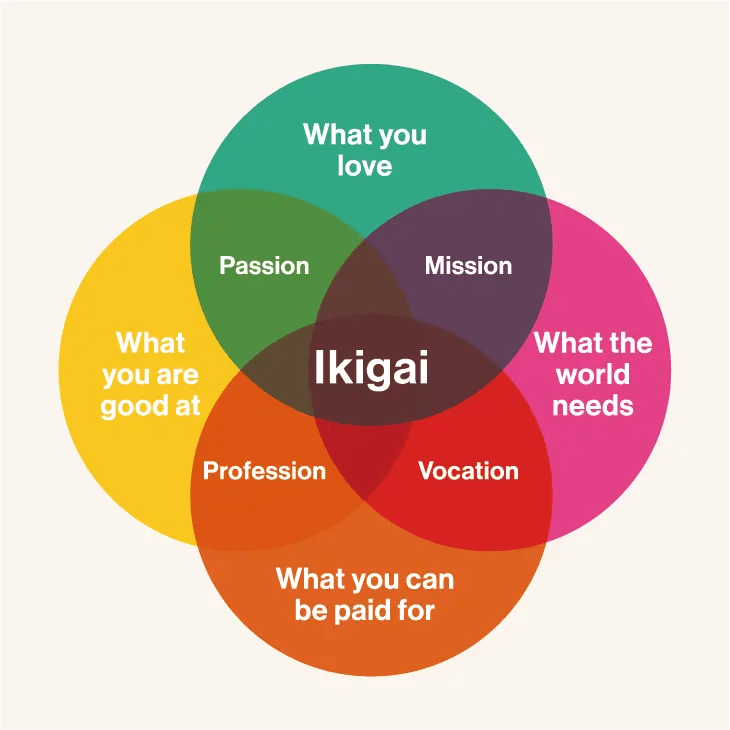
- What do I like?
- What am I good at?
- What does the world need?
- What can I be paid for?
Your Ikigai is where the answers overlap.
For example, the world needs Artificial Intelligence (AI) professionals today and customers are willing to pay for it. However, if you don’t master AI, even if you like technology, this is not going to be your Ikigai.
Likewise, you might excel at taking pictures with analog cameras, but in general there is no high demand for this skill right now.
If you struggle with identifying your Ikigai, think what you wanted to be when you were a child. An astronaut? A teacher? This might indicate that your ideal work, or Ikigai, is something adventurous like war reporter, or something that helps educate people, like content creation, respectively.
Having a career vision aligned with your Ikigai is not required, but it makes it more sustainable and fulfilling in the long run.
Shaping your ideal job
Once your career vision is clear, you can just stop there and simply wait for things to develop. There will be opportunities, decisions and offerings that you will probably accept of decline depending on their level of alignment with your vision. We don’t need to have everything figured out, and sometimes it’s better this way, because this allows us to wait for the right opportunity to present.
However, in some circumstances, you might proactively pursue a change. For example, you are relocating, and you need a new job in your new town. Or you work in a toxic environment that is taking toll on your mental health.
The next step suggested is to define how you would like your day-to-day to be, the specifics of the job.
For example, do you…
- … prefer going to the office and seeing people in person, or working from home?
- … appreciate schedule flexibility, even if this entails working overtime occasionally, or do you prefer predictability, even if this means that you need to schedule your chores around it?
- … value salary over everything else?
- … thrive in front of customers, or prefer a back-office role?
- … need close supervision, or work better with less directed management?
- … enjoy generous paid time off (that you can actually take) or a few days is enough?
- … prefer leading a team, or being an individual contributor?
- … need a full time or part time job?
- … prefer the safety of a fixed salary, or prefer to work on tips/commissions?
- … prefer to work on your own, of be a team member?
The answers to these questions, and similar ones, help you shape your ideal job.
Building the bridge
At this point, you know what you want to be (your vision or Ikigai) and how you want it (your job characteristics). It’s time to build the bridge between now and the future.
And I have another list of questions for it.
- What skills do you already have for your target job?
- The goal is to identify skills you can use right away. Some may be obvious, but you can probably identify more.
- Reflecting on situations when you were successful can be helpful. What made them a success? Maybe extensive preparation? Teamwork led by you? Knowing your client’s pain points? Anticipating objections? Being aware of what’s going on in the specific market? Your ability to build rapport and credibility with the customer? Showing flexibility?
- Write a list and keep it handy to remember how good and prepared you are!
- What, if any, skills do you need to develop?
- This is the same exercise, but from a different perspective.
- You may already know what you’d need to learn or gain experience with for your target job.
- Or you can evoke past situations when you needed help or thought you were not ready, when you struggled. Is that skill or knowledge relevant for your target job?
- Skills can be either expertise based (knowledge) or so-called soft (communication, negotiation, expectation management, etc.)
- How can you gain these necessary skills?
- Depending on the skill itself, self-study of instruction led training, mentoring, shadowing, volunteering, gigs, etc. can be the best tool. This is also very personal. Some people learn better reading, others listening, others with hands on practice. Choose what works for you.
- Start small: focus on the 1 or 2 skills that are either the most relevant, or the easiest to achieve (low hanging fruits) and set SMART goals for them.
- SMART goals are Specific, Measurable, Achievable, Relevant, Time bounded. For example:
- If you want to gain confidence with public speaking, you might want to set the SMART goal of “presenting in our weekly team meeting twice a month for the next six months.”
- If you need to learn more about AI, your goal can be “check out at least 5 AI courses in Coursera this week and sign up for one, to start on the next available date that works with my schedule”.
- SMART goals need to be Achievable, not Aspirational. That is, realistic. Ask yourself: in a scale of 0 to 10, how confident am I that I can accomplish the goal? Why?
- For example, if you are in the middle of a demanding customer project, presenting twice a month at the team meeting may not be achievable (confidence 3). Presenting once a month may be more realistic (confidence 8).
- Prepare for success: what challenges do I anticipate accomplishing the goal? How can I mitigate them?
- For example, if you have a vacation planned soon, you might want to sign up for the AI training to start after the vacation.
A few more tips
- Build your personal brand. Harvard Business School defines personal branding as the intentional, strategic practice of defining and expressing your value. By building your reputation, you can stand out and be the name that people recall when new opportunities aligned with your interests and values are created. Stay tuned for a future article about personal branding.
- Find ways to show your skills – and your brand – beyond your close group. You may want to actively participate in your company’s channels, like collaboration groups, Microsoft Teams channels, cross trainings, technical blogs, employee events, etc. You might want to also consider external channels like LinkedIN, professional listings, business related groups like Toastmasters, create your personal blog or podcast, etc. Show leadership, put yourself out there. Because “It is not what you know, it is not who you know, it is who knows what you know.”
- If allowed, don’t just do your work “to the letter”. If you have the freedom and the time, proactively take on more responsibilities in your areas of interest, offer to mentor, request training, etc. Don’t wait to be asked. This shows leadership and it’s generally welcomed.
Conclusion: the growth mindset
Taking control of our career is key, whether we are proactively pursuing a change or not. The current work environment is rarely static. It is wise to start moving in the direction we choose, before being put on a different route.
Setting our career vision is the compass for our professional actions. Identifying the characteristics that shape our ideal job, regarding things like schedule flexibility, salary, vacation time, location, etc. helps identify the opportunities as they arrive. In preparation for our desired job, we need to identify the skills we already have, those that we need to acquire, and build an action plan based on SMART goals to fill in the gaps. Being conscious of personal branding and showing our value through internal and external channels helps us be visible and open doors.
In the end, it is all about having a growth mindset: a mind that is receptive to opportunities that might open in front of us. Change is often uncomfortable; being ready can make the process less challenging. Change, either subtle or significant, is unavoidable too. We’d better be prepared and in as much control as we can.
Be well, be courageous, be successful.
And first and foremost, be well.

