
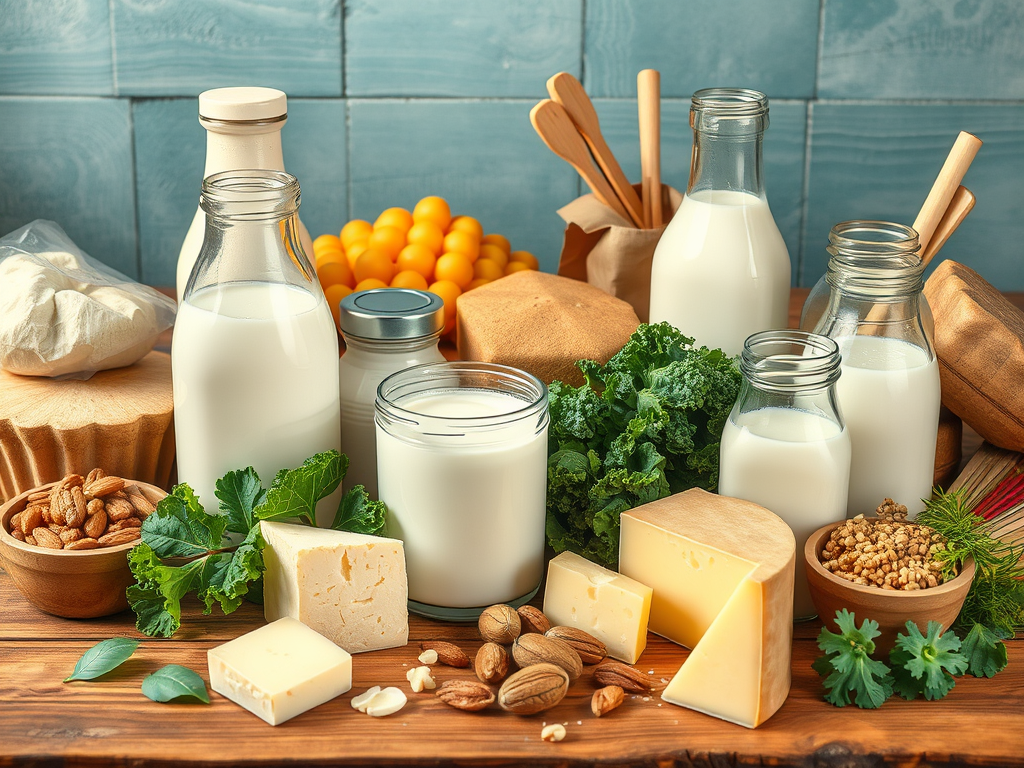
Dairy… some love it, some loath it. Which team are you? Personally I have been in both for many years. I loved cheese but in general didn’t care for anything else..
Regardless our inclination, most of us will eat dairy anyway because it is an excellent source of calcium. And calcium is needed for our bones at any age:
- when we are still growing and developing, we want those bones to form optimally
- later in life, we need to preserve our bone density as much as possible.
Besides making up our “scaffolding” (our skeleton), calcium takes part in many other vital processes of the body, for example muscle contraction. Calcium is the most abundant mineral in our body, and we need large daily amounts:
- The Recommended Daily Intake (RDA) vary per gender and age.
- In the the USA, the RDA for adults between 19-50 years is 1000 mg of calcium.
- Interestingly, other countries have different recommendations; for example, in the UK the RDA for this same age group is 700 mg instead of 1000 mg.
Even if there are multiple sources of calcium, including plant-based ones, it is true that dairy contents the highest amounts and makes it easy to reach the 1000 mg RDA with just 2-3 servings per day.
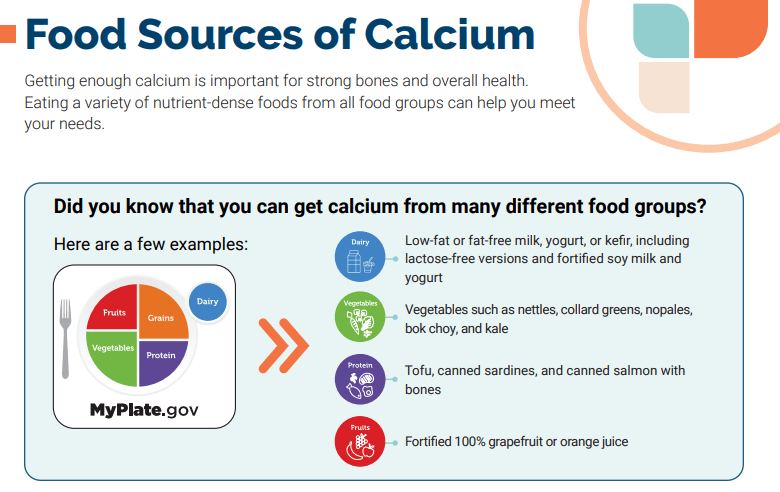
Source: https://www.dietaryguidelines.gov/food-sources-calcium#standardcalcium
Beyond calcium
Have you ever thought what else is provided by dairy? It’s not a short list:
- Saturated fat, unless we are choosing skim or reduced-fat milk.
- Natural occurring sugars, especially lactose.
- Some animal protein, including casein.
- Casomorphin. When digested, casein is broken down into casomorphin, an opioid that can cause the brain to release dopamine.
- Added sugars, in some yogurts and other prepared desserts or drinks.
- Probiotics in yogurt and kefir.
- Traces of female caw hormones, including estrogen. The jury is still out whether this poses a risk for public health or if it does not; there are studies indicating both.
- Somatic cells from the caw, primary white blood cells (leukocytes) and milk-producing cells (epithelial cells). Somatic Cell Count (SCC) is a measure of the number of cells in milk and a key indicator of milk quality and the health of cows. Maximum SCC is regulated by the FDA in the USA, and by other institutions in another countries. Maximums vary per country.
- High amounts of sodium, especially in cured cheese.
Some of this might be surprising. But if we realize where milk comes from (mother caws) and what’s its role in nature (feed a baby caw that eventually will develop into an adult caw), it makes sense.
Lactose and casein can cause digestive issues
Lactose is usually blamed for dairy intolerance. We are born with lactase, an enzyme that allows us to digest lactose. Lactase goes away as we grow older and are no longer expected to be fed with mother’s milk. Some people have developed the evolutive adaptation of keeping the lactase throughout their lives, as a result of persistent exposure to lactase. These people tend to digest dairy better.
However, there’s another less-known substance in milk which can cause intolerance: casein. There are two main forms of casein: A1 beta-casein and A2 beta-casein. A1 is the most common nowadays, yet some individuals have difficulties digesting it.
Bottom line: even if you are not intolerant to lactose, dairy can still give you digestive distress if you are sensitive to casein.
The case of cheese
Cheese can be seen as a concentrated form of milk, with much more fat and sodium than milk itself. The fatty, smooth texture makes it very palatable and comforting.
As I mentioned, the milk casein is converted into a casomorphin in the body, which can trigger the brain’s opioid receptors, the same receptors that are activated by prescription pain pills and even heroin. As a result, the feel good hormone, dopamine, is secreted. Some argue that this is why cheese, and dairy in general, can be so addictive. This theory has not been proved, but the debate is open.
If you think about it, nature is wise and usually rewards us and makes us feel good with things that are essential for life continuity, like food. Nature wants the baby caw to eat mum’s milk, and rewards the baby with feel good sensations after eating her milk, so they keep coming back for more, eating and growing.
Animal welfare
[Warning: this section may be hard to read for some]
And speaking for caws and calves…
A caw only produces milk after giving birth – like humans and all other mammals do.
Which means that milk caws need to be basically pregnant all their lives.
Caws are artificially inseminated, and as soon as they give birth, the calf is removed and they are connected to the miking machine until they dry. Then the process starts again multiple times until the caw is not able to produce more milk. At this moment, the caw is usually slaughtered for low quality meat.
And what happens to the baby caws that are born? If they are female, they will become milk caws when they grow. If they are males, they are either slaughtered right away or used for low quality meat too.
Not to forget that caws are mothers, and as any mom, do suffer when her baby is removed from them. Over and over in her (sad) life.
I know this is hard to hear, and some even deny the veracity. Sorry readers, the milk industry doesn’t want us to know all this, but dairy farming is not kind.
Furthermore, milk production has a huge environmental impact, in terms of carbon footprint, water use and contamination.
Making informed decisions about dairy
So far I have been trying to explain the good, the bad and the ugly of the dairy products and industries. I hope you are now armed to make an informed decision about your calcium sources. Because going back to the opening of the post, the main reason why we eat dairy is to get calcium, we do need calcium to be healthy.
If you choose to get calcium from dairy
Here are my tips to get the best from dairy and minimize the less good:
- choose low fat or no fat milk and yogurt
- choose no added sugar yogurt, preferably plain
- if you are not lactose intolerant but still don’t digest well dairy, look for A2 milk. Health stores like Whole Foods carry this type of milk.
- if you can, choose organic, to minimize SCC and alike.
- avoid cheese, or use very sparingly and as a condiment.
If you choose NOT to get calcium from dairy
The main plant-based options for calcium are:
- Calcium fortified plant-based milk. My recommendation is plain, unsweetened soy milk, as it has higher protein content and the benefits of soy. Silk Organic is my go-to, and as a bonus it is also enriched with vitamin D2 and B12. Alternatively, a seed or nut milk, like almond, oat, cashew or hemp. I do not recommend coconut milk, due to the saturated fat content. Always check for added sugar content.
- Dark leafy greens, like kale, collards, mustard greens, spinach, etc.
- Tofu set with calcium salt. Most of it is, but some softer variants are not; check labels.
- Sesame and tahini (sesame butter)
- Oranges and enriched orange juice.
- Almonds.
| FOOD | SERVING | CALCIUM MG |
| Collard greens, cooked | 1 cup | 268 |
| Spinach, cooked | 1 cup | 245 |
| Taro root, cooked | 1 cup | 204 |
| Turnip greens, cooked | 1 cup | 197 |
| Bok choy, cooked | 1 cup | 185 |
| Kale, cooked | 1 cup | 177 |
| Mustard greens, cooked | 1 cup | 165 |
| Tofu, set with calcium sulfate | ½ cup | 434 |
| Soy milk, fortified | 1 cup | 301 |
| Tahini (sesame butter) | 1 tablespoon | 154 |
Source: https://www.dietaryguidelines.gov/food-sources-calcium#standardcalcium
Bonus, these foods don’t come with the downsides of dairy. On the contrary, they are loaded with nutraceuticals and most of them can be considered functional foods. And they don’t require animal farming.
The only caveat is that some of the greens can be high in oxalates, that can interfere with the calcium absorption. Spinach is the highest in oxalates. The best way to reduce the oxalate content is to eat them cooked, not raw. Minerals, like calcium, are not affected by heat.
Calcium does not work in isolation
Calcium is vital for bone health, but let’s not forget that it does not work in isolation. We need many other nutrients to work in conjunction with calcium to build and repair our bones. For example, vitamin D, magnesium, omega 3 and protein. Keep an eye on those as well.
How do I know if I’m taking enough calcium?
As mentioned, calcium takes part in many vital functions besides bone building. You can have your calcium levels checked in a blood test, however this won’t tell you if you are taking enough calcium. The body is wise, and it will take calcium from the calcium storage (your bones) to supply it for those other functions. If this situation is held for a long time though, the calcium stores can be depleted and lead to osteopenia and osteoporosis, which are low bone density conditions.
The best way to know if you are taking enough calcium is to get the blood test and a bone density scan like DEXA. Medical insurance covers the DEXA scan in some cases, but you can also get it on your own by a reasonable price at places like Dexafit. https://www.dexafit.com/
Drum roll, please! Do we really need dairy for bone health?
No, we don’t.
Dairy is considered a staple of the Western diet, and it sustains a big industry. However, you don’t need dairy to get your calcium.
In Eastern cultures, especially Asian cultures, there’s no dairy. Visit your local Asian grocery store and you won’t find dairy of any type. What you would find instead is a bounty of dark green leafy vegetables, variety of calcium-set tofu options and seeds like sesame, all high in calcium (and phytonutrients).
Your non-dairy calcium action plan(t)
If you are ready to quit dairy, start small. A general action plan can be:
- replace caw milk by calcium-fortified plant-based milk
- incorporate more green leafy greens in your diet
- cut your cheese intake in half
- introduce calcium-set tofu a few times per week
- reduce the amount of cheese per intake, for example half of it
- if you are struggling to quit cheese, explore the market for good quality plant-based options, usually made from cashews; watch out for high saturated fat content.
Dairy or not dairy, the decision is ultimately yours.
But please get your calcium somehow.
 thrivebytheslice.com
Well done post!