

We may not always like it, but hunger is a vital sensation, an attention call from our body to get the nutrients it needs to survive. We are born with a self-regulated ability to eat when we are hungry. Babies will certainly (and loudly!) demand food, if it is not provided in a timely manner.
Unfortunately, this innate skill could be impaired as we grow up, either by our environment, like fixed meal schedules, or own our bodies, like metabolic issues. Consequently, we may end up with unwanted weight gain, or a permanent sensation of emptiness or need for self-control that potentially promotes mental issues. To avoid all this, it is useful to get familiar with the hunger process and, if needed, implement strategies to get it back to how it was meant to be. I will be providing some advice in this article.
But first, let’s start by clarifying the difference between hunger and appetite. Even if these are two terms can be used interchangeably, they refer to different things:
- Hunger is the physical need to eat. In healthy people, it is naturally regulated by the body by some hormones (ghrelin and leptin mainly), the feeling of empty stomach or a drop in blood sugar levels. It is our body’s call for food.
- Appetite is the desire to eat, due to psychological factors. For example, when we are stressed out, bored, or even when our senses have been stimulated by the look or smell of food.
In this article, I am going to focus on hunger, not appetite. Most of the techniques that we can use for hunger control are valid for appetite too, complemented with additional mindfulness or even therapy interventions to address the mental side.
How hunger is signaled
Our bodies need food to survive, that’s why we have ingrained mechanisms to make sure that we eat regularly.
The hormone ghrelin is produced in the stomach, typically when it is empty, and signals the brain to stimulate the feeling of hunger. As we eat and the stomach starts to fill up, the ghrelin production is inhibited. Unless we eat only fat, when nutrients are absorbed, the blood glucose levels will increase, which will trigger insulin release (another hormone). Insulin can also inhibit the ghrelin production, suppressing the feeling of hunger. The hormone leptin is segregated in fat cells to sign satiety, and our desire to eat ends. Therefore, in a healthy body, the cycle hunger-satiety is self-regulated.
However, this mechanism may not work well in people with insulin resistance, or excess of body fat, since both can disrupt the signaling.
Your levers for hunger control
Now that we know how hunger is triggered, we can identify the levers we can pull to increase our control over it. To start with, we want to avoid an empty stomach for long periods and avoid insulin spikes. We also want to train our body to tolerate longer times with an empty stomach, and regulate our insulin production. Here is how to do it.
1 – Increase fiber intake
Why it works: fiber slows down the stomach evacuation rate, therefore keeping it full longer, and modulates glucose absorption.
Recommendation: 25-40 grams per day. Good sources are whole grains, vegetables, fruits, beans, nuts and seeds.
2 – Eat enough protein
Why it works: protein takes longer to digest, staying in the stomach for longer.
Recommendation: Minimum 0.8 grams of protein per kilogram of body weight, ideally 1.2-1.5 grams depending on activity level and age. You can get it from lean animal sources or, preferably, plant sources like beans, soy products, nuts, seeds and grains.
3 – Choose low GI (Glycemic Index) food
The GI represents how much a food raises blood glucose when absorbed. Glucose itself has a value of 100, and It ranges from 0 to 100. A GI less than 55 is considered low, a GI between 56 and 69 is considered medium, and GI more than 70 is high. Notice that, unless we eat a food on its own, the global GI of a full meal will be a combination of the individual foods. So a meal made up of low GI foods will be low GI, whereas a meal with both high and low GI foods in similar amounts will have a medium GI. Another interesting concept is Glycemic Load (GL), that also considers how fast the sugar levels are raised.
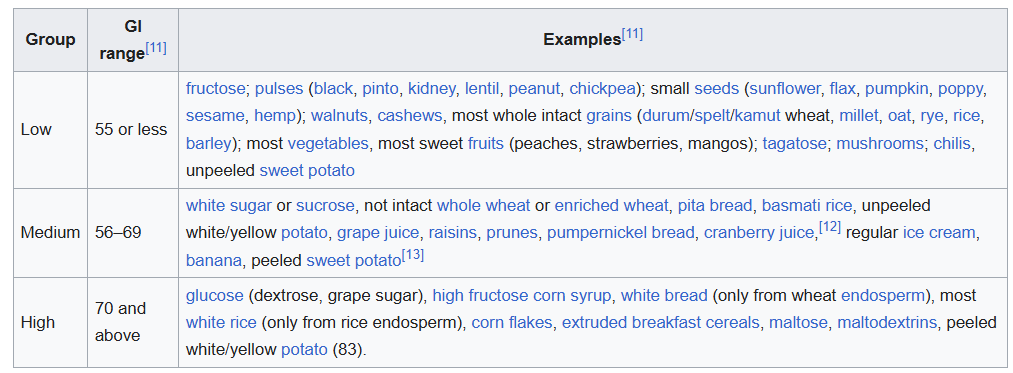
Why it works: GI and GL are related to insulin, as this hormone is segregated to return sugar levels to stable levels. Low GI or GL foods won’t raise insulin sharply, and won’t interfere with our body innate signaling.
Recommendation: focus on food with low to medium GI, typically those high in fiber like vegetables, whole grains and most whole fruits. If you eat food with higher GI combine it with protein, fat or fiber to reduce the resulting glycemic load of the meal. A good combination is a ripe banana (high GI) with peanut butter (low GI).
4- Use fat wisely
Why is works: fat does not increase insulin and takes long to digest.
Recommendation: include a small amount of healthy fat in each meal, especially when eating carbs and protein. Prioritize whole food fats like nuts, seeds, nut butters, avocado or fatty fish, and use cold-pressed oils in moderation. Small amount is 1 tbsp of nuts or seeds, 1/4 avocado, 1 tsp of oil.
5 – Optional: Try intermittent fasting
Why it works: it helps our bodies get used to longer times without food in our stomach, without triggering the hunger sensation. It avoids insulin fluctuations.
Recommendation: there are many types of fasting, but I find the 12:12 protocol the easiest. This means eating for 12 hours, and fasting for 12 hours each day. The 12 hour fasting window is usually easy to achieve with an early dinner (7 pm) and a late breakfast (7 am). Please check my article about intermittent fasting for more information.
Intermittent fasting is not for everyone. Feel free to skip it and focus on the other tips.
Conclusion
Our bodies have an innate capacity to regulate the hunger and satiety cycle, but unfortunately our environment and other bodily conditions can disrupt this process.
The good news is that we can restore the process with the right dietary approaches, especially making sure that our stomach is not empty for too long, and that our insulin doesn’t spike. Eating enough fiber, protein, healthy fat and low GI foods are simple tools we can use.
Questions? Comments? I read you in the comments.
 thrivebytheslice.com